The role of copepods in a reef aquarium ecosystem
Zooplankton in a reef aquarium is composed of several groups of marine organisms, more than 80% of which belong to the copepod family.
Copepods make up the microfauna and macrofauna of our marine aquariums; understanding how they function, reproduce, and their utility will allow for better aquarium stability.
The microfauna refers to all zooplankton smaller than 0.2 mm, and the macrofauna refers to animals whose size ranges between 4 and 80 mm and which can be easily observed with the naked eye.
Copepods are a specific type of zooplankton. In other words, all copepods are zooplankton, but not all zooplankton are copepods.
Copepods are a class of zooplanktonic crustaceans. They are very common and abundant animals in oceans, lakes, and rivers. They are often very small (on the order of a millimeter), but they constitute an important part of the zooplankton. Copepods feed on phytoplankton, organic matter, and zooplankton smaller than themselves. They are also an important source of food for fish, seabirds, and other marine animals.
The origins of copepods
Copepods belong to the class of crustaceans, and there are more than 14,000 species identified to date, 10,000 of which are marine. Copepods are small crustaceans whose adults usually measure only one or two millimeters (the smallest species measure about 0.2 mm and the largest about 10 mm).
The term copepod is derived from two Greek roots: kope which means oar and podos which means foot. The name of these animals thus refers to their oar-shaped legs.
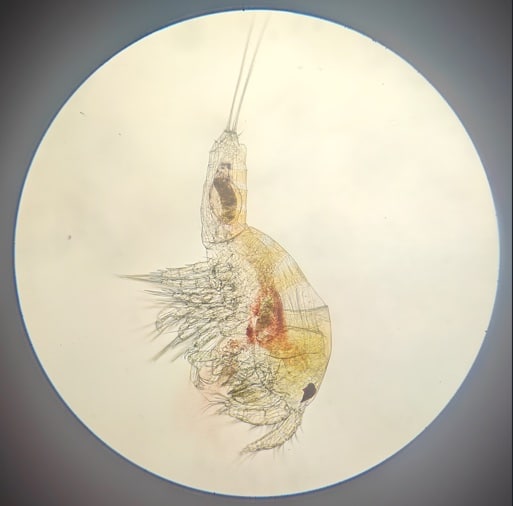
Copepods represent between 60% to 80% of the zooplankton biomass, making them the main element of zooplankton.
Photo: Harpacticoida copepod under a microscope VWR Visiscope 200 taken by Nicolas Mazo
Adult copepod morphology
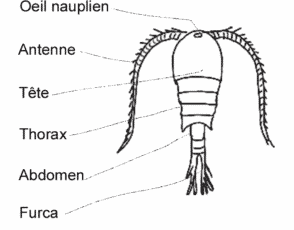
• The head, or cephalosome, is composed of 6 fused segments.
• The metasome or thorax is composed of 5 elements, or thoracic segments.
• The abdomen is also composed of 5 segments (forming the urosome).
• The last segment bears the anus as well as two more or less developed extensions forming the furca.
• The head and thorax constitute the cephalothorax.
• The appendages, or antennae, are often approximately equal in length to the body. They often bear a large number of setae which can play a sensory role, intervene in capturing food, and participate in locomotion. They are often used to distinguish between different species of copepods.
We are interested in two main groups of copepods:
- Harpacticoida, which are entirely benthic. They live on the bottom or within the sediment itself, often at the bottom of the aquarium or on the walls.
- Calanoida, meaning copepods that are pelagic, which live and move in free-swimming suspension in the aquarium’s water column.
Where do the different types of copepods live?
Benthic Harpacticoida copepod
Copepods belonging to the order Harpacticoida live at the bottom of the water, on the substrate, rocks (crevices of live rocks), but also on the glass and other surfaces.

Benthic copepods are easy to recognize because they have a very short first antenna.
Photo: Benthic copepod of the order Harpacticoida with eggs
They feed on dead organic matter: sludge or detritus and micro-algae from the water, and are thus very good detritivores.
They are highly prized by Synchiropus splendidus (more commonly called the Mandarin dragonet), and other dragonets, blennies, gobies, and other creatures that hunt on live rocks or the substrate.
Juvenile copepods are about 100 microns and are valued as food for fish larvae.
This group of copepods is easy to maintain and accepts variations in temperature and salinity without much problem (Salinity 20 – 34 ppt / Temperature 15-28°C)
Calanoid planktonic copepod
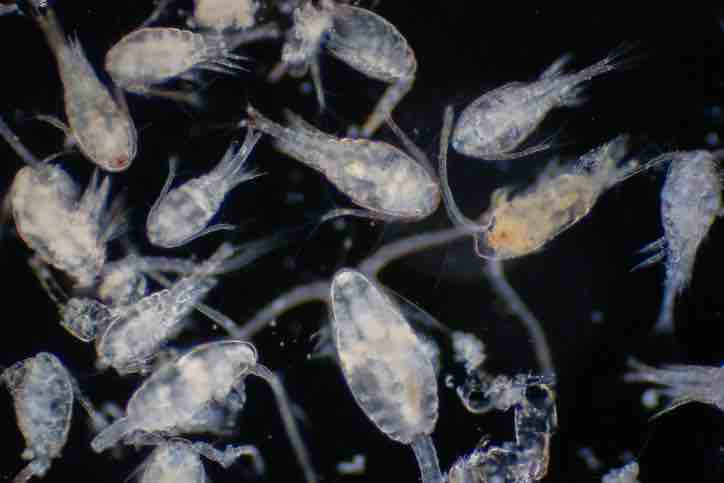
Copepods belonging to the order Calanoida are recognized by their large antennae. Most of the time, they are in the water column and are difficult to maintain in our reef aquariums (often eliminated by filtration and the skimmer).
Photo: Tiger copepod or Tigger-Pods under a microscope
Their only interest is as food for their predators (macrofauna, fish larvae, and other organisms).
They have a life cycle of about 30 days and mainly consume phytoplankton. Finally, some species are very tolerant of temperature and salinity.
Because they do not live on the substrate like Harpacticoida but in the water column, reproduction in a reef aquarium is impossible as they will serve as food for predators.
What does a marine copepod eat?
It differs according to the type of species, growth, and even seasons; however, they have some points in common:
There are herbivorous copepods and carnivorous copepods.
Herbivorous copepods are almost always filter feeders and feed on small unicellular algae (about 5 to 50 µm) in both fresh and salt water.
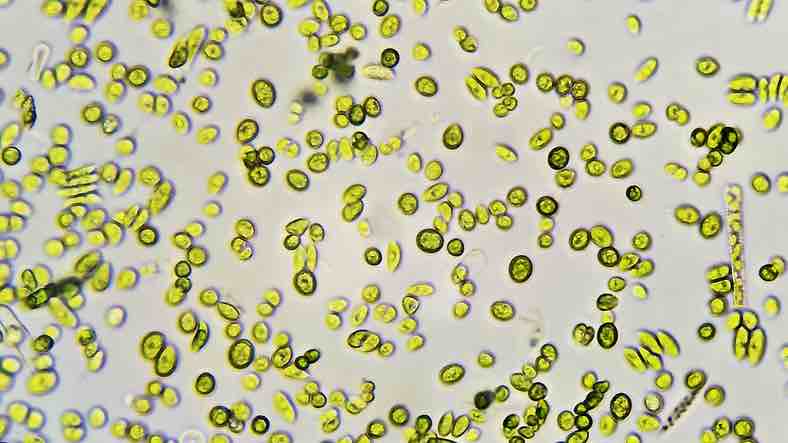
The most appropriate phytoplankton strains for their development are the Tetraselmis suecica strain and the Nannochloropsis oculata strain.
Photo: Phytoplankton under a microscope
There are also carnivorous copepods that do not filter the water but catch their prey after detecting movement (mechanoreception) or chemical scents (chemoreception). These prey can be very small multicellular organisms such as rotifers, larvae of other crustaceans, or even other copepods.
In between, we have many species of copepods that have a diet that is both herbivorous and carnivorous and which participate in cleaning organic detritus when it is abundant in the aquarium.
More globally, given their diversity, copepods are very important in the balance of our reef and marine aquariums because they are at the base of the food chain and thus provide the link between the microbial world and the macrofauna. Thanks to them and the predation exercised on different microbial levels, copepods allow for the regulation of these populations and participate in the recycling of organic matter.
Ultimately, a reef aquarium without their presence could lead to the asphyxiation of your aquarium.
Indeed, even if microfauna is very present with the addition of live rocks, it will gradually disappear due to lack of care and food supply.
The addition of marine phytoplankton is a way to maintain and preserve it!
Copepods living in the reef aquarium
Marine copepods are small crustaceans that can play an important role in the maintenance of a reef aquarium. They are generally used as food for corals, fish, and other invertebrates.
In addition to being a source of food, marine copepods can help maintain a healthy biological balance in the aquarium. They feed on algae and organic matter suspended in the water, thus helping to maintain clear and limpid water.
Furthermore, marine copepods can also help prevent infestations of harmful algae and parasites by competing with them for food and by eating them.
It is important to maintain a sufficient number of marine copepods in the aquarium to ensure their effectiveness.
Aquarists can therefore introduce copepods into their reef aquarium using specific foods or by purchasing them directly from specialized sites.
If your tank is very poor in microfauna, we advise adding or replacing a few rocks with fresh live rocks teeming with natural microfauna, or adding the zooplankton mix.
Video of a drop of Zooplankton where you can observe copepods with the naked eye and then under a microscope of open-water microfauna:
Breeding or culture of copepods
Another solution is to carry out a copepod culture at home to distribute them regularly in the aquarium.
To carry out copepod breeding, we have created a complete tutorial that explains the different phases of culture.
Complete tutorial for starting a copepod culture.
Photo: benthic copepods in culture
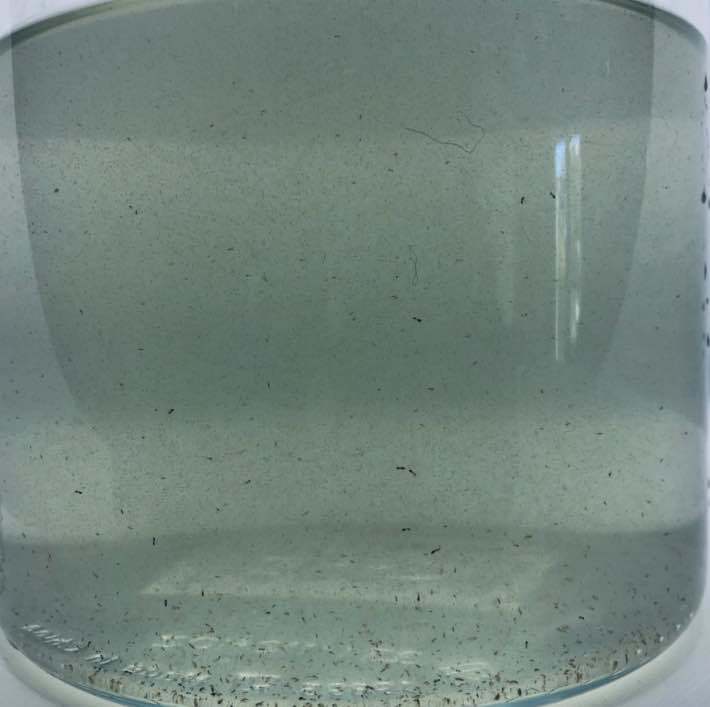
You can add the Zooplankton Mix for sale on the site directly to your reef aquarium (preferably in the evening), which is also used to start a zooplankton culture.