
Most polychaete worms are highly beneficial in a marine reef aquarium; they are excellent detritivores. This article will help you identify unwanted worms in order to protect the beneficial worms that help maintain balance in a reef aquarium.
Fear of the unknown, or the bad “press” surrounding worms whose diet includes coral polyps, bivalves and sometimes fish, often leads to the destruction of any polychaete worm (an annelid worm with many bristles).
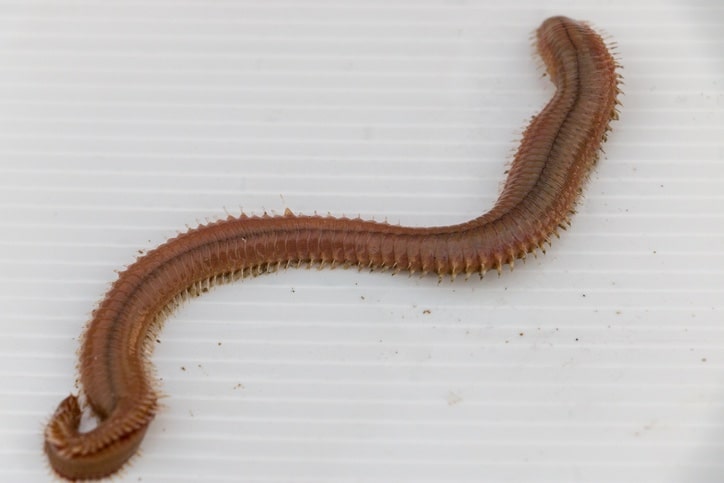
Lumbrineris sp, Nereis sp, Nephtys sp, Eulalia sp, Glycera sp and certain other polychaete worms are very useful in the aquarium and completely harmless.
IMAGE: Nereis sp polychaete worm
The article covers the following worms:
- Eurythoe fireworms. Eurythoe is a fireworm that stings fingers, but it is completely harmless to the animals that live on coral reefs.
- Hermodice carunculata fireworms. They can severely irritate fingers and coral, and may even eat their polyps.
- Eunice aphroditois, the predator that can devastate a reef aquarium if it is not captured.
Eurythoe fireworms
As true scavengers, Eurythoe fireworms feed only on dead animals, which sets them apart from predators such as Hermodice carunculata.
Eurythoe fireworms can also sometimes extract food from corals or sea anemones. The worms generally live in crevices or holes in the aquarium rocks and come out to look for food after nightfall.
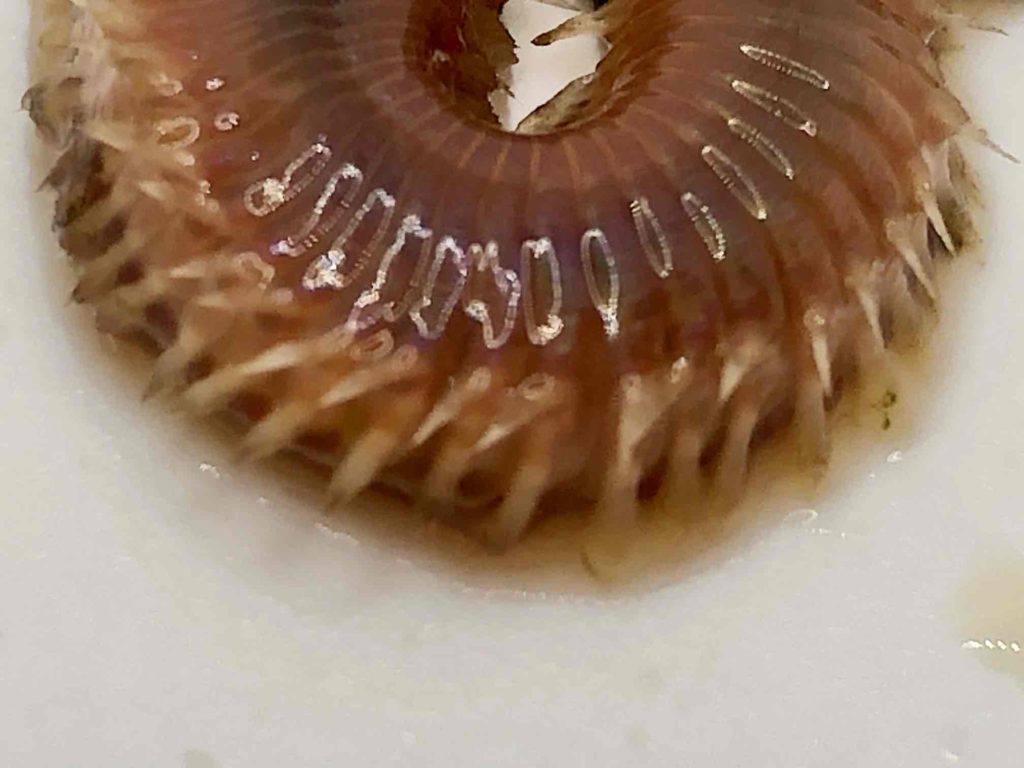
Tufts of white bristles on a Nereis sp polychaete worm
Because of their habit of living in rocks, they enter the aquarium imported directly in live rock or newly purchased coral. These worms can grow very large and reach up to 40 cm in length.
They have a number of unique physical characteristics:
- They have an oval or almost rectangular cross-section.
- They have large tufts of white bristles on each side of every segment.
- They have a flat area continuous with the head, extending several parts of the head backward along the top of their back.
- They have fine pink or orange gills above each tuft of bristles.
- Their base colours are pink, orange-pink or beige.
Warning: fireworms are dangerous in seawater
All fireworms, including Eurythoe, are dangerous to touch.
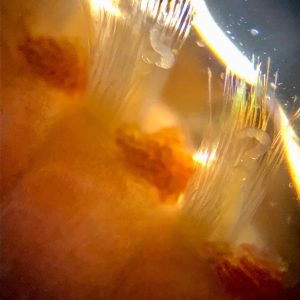
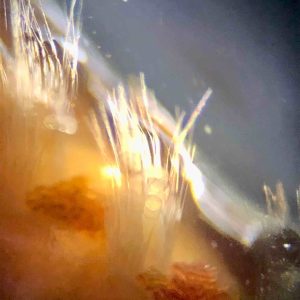
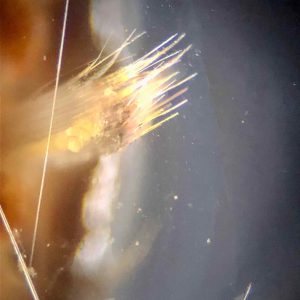
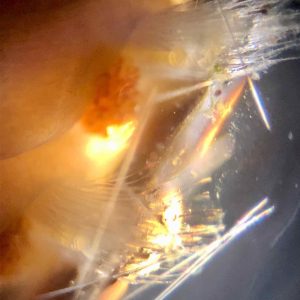
Their white bristles are brittle and hollow. Inside, they may be filled with venom released when they break. The bristles appear designed to pierce flesh.
When a predator or a careless aquarist tries to grab a fireworm, the fireworm’s bristles pierce the skin, break, and release their irritating venom.
Although irritation in humans is generally mild, it can be quite painful for sensitive individuals.
It is therefore best to use tongs or gloves when you put your hands in the aquarium.
Close-up of the white bristles of a fireworm under the microscope:
Hermodice carunculata fireworm from the Amphinomidae family
The Hermodice carunculata fireworm, commonly known as the bearded fireworm, is a fireworm found in seawater and belongs to the Amphinomidae family.
Unlike other beneficial worms in our aquariums, this fireworm is not harmless to corals.
Hermodice carunculata is the only problematic fireworm in the aquarium. It feeds on corals and gorgonians in its natural habitat and can therefore feed on the aquarium’s SPS, LPS and soft corals.
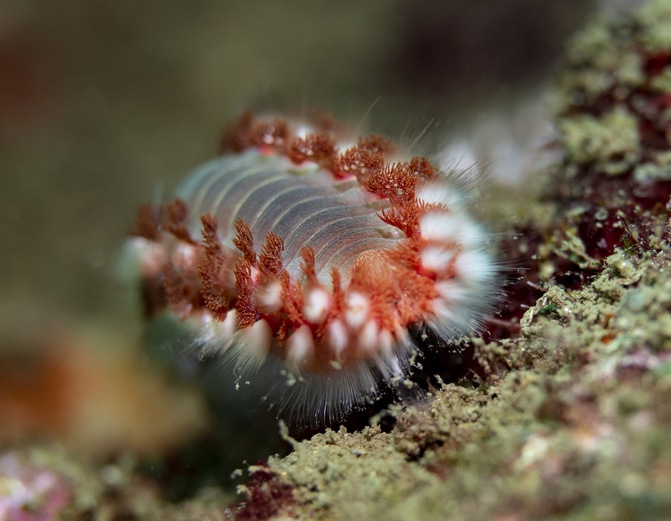
Hermodice carunculata is the only harmful fireworm in the reef aquarium, as it attacks corals, bivalves and gorgonians.
IMAGE: Hermodice carunculata worm
As the worm has no jaws to cut off pieces of prey, a long process begins.
When feeding, individuals usually swallow the tip of a gorgonian or a soft coral, then lick its flesh while the tip is still attached to the colony. Such feeding is a lengthy process that takes several hours. During this time, the worm does not go anywhere; it clings to its dinner.
The polychaete worm Eunice aphroditois
We could not address the topic of unwanted worms without mentioning Eunice aphroditois.
This is not a fireworm, but a giant worm that is the reef aquarist’s nightmare. Imported directly in live rock, it is a formidable predator.
Easily recognised by a rather short head that contains two lobes and bears five long antennae, with shorter tentacles around the mouth opening.
Its jaw will clamp down on the reef aquarium’s inhabitants, decimating invertebrates, fish and other marine animals near its refuge.
IMAGE: Eunice aphroditois
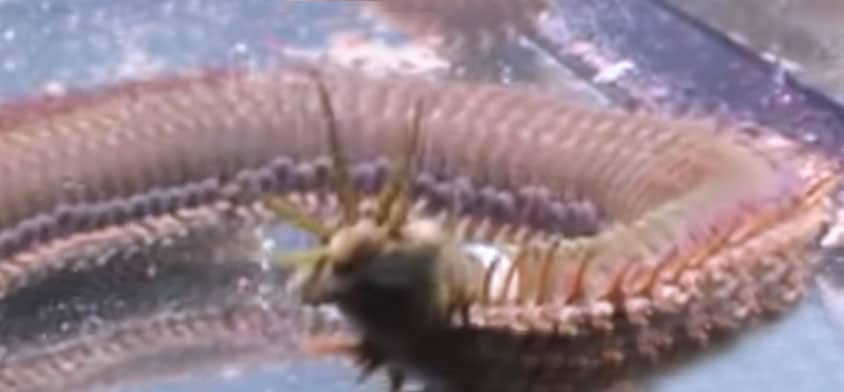
The body is dark purple, sometimes iridescent green, with grey markings and a whitish-grey transverse band near the end.
The segments are flanked by short appendages whose shape changes gradually along the body’s longitudinal axis without sharp transitions.
The body is widest near the front end (around the height of the tenth segment) and narrows considerably toward the rear. The muscular front end is used to move the retractable mandible mechanism.
How to catch and get rid of fireworms?
If you have a Hermodice fireworm in your aquarium, you will eventually find it chewing on its prey or crawling on the substrate. Remove it with tongs.
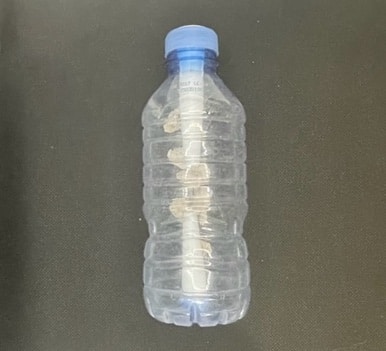
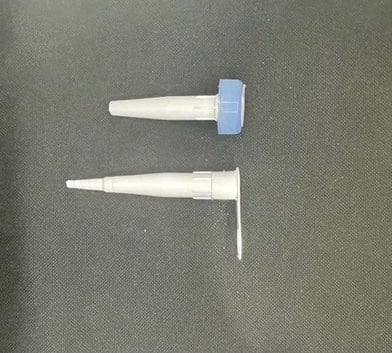
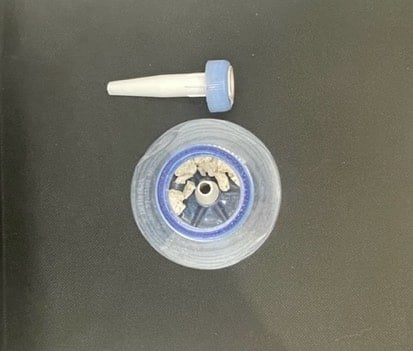
Here is an easy trap to make to lure the polychaete worm Eunice aphroditois or the fireworm Hermodice carunculata out of hiding:
- Take a small plastic bottle and, at both ends, pierce it and add a nozzle similar to a silicone cartridge tip.
- Cut the nozzles so that the worms can pass through.
- Weight the bottle with substrate so that it rests on the bottom of the aquarium.
- Add bait such as fresh mussels, shrimp or other crustaceans.
- Place the bottle on the bottom of the aquarium in the evening, ideally in front of the rock where you think the Eunice is hiding.
- Lift the trap in the morning and check that it does not contain polychaete worms. If it does, we recommend putting them back in the aquarium.
Polychaete worms are excellent detritivores
Apart from a few fireworms that can slowly damage corals, and the Eunice aphroditois worm, which is dangerous for the reef aquarium’s inhabitants, most polychaete worms are excellent detritivores and therefore help maintain the balance of the reef tank. Like the microfauna, they will clean up waste and thus stabilise the biotope created.

