Sooner or later, you will encounter brown algae in your aquarium. Most often, these algae are diatoms. What can be done to remove these unsightly algae? This article aims to identify diatoms, understand how they develop, and provide you with the means to take action.
How to identify diatoms in an aquarium?
Diatoms are microscopic algae that live in the water and belong to the plant-based marine plankton: phytoplankton. They can be found in the aquarium’s water column, but they are most commonly found on the sand or the glass.
Often confused with dinoflagellates, they will disperse like a cloud of dust if stirred, unlike dinoflagellates, which remain clumped together.
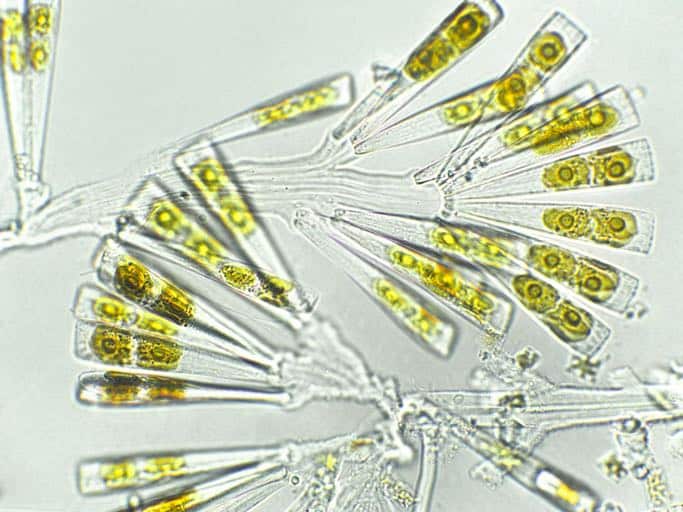
Yellow and brown in color, their size varies between two micrometers (micron, or one-thousandth of a millimeter) and one millimeter.
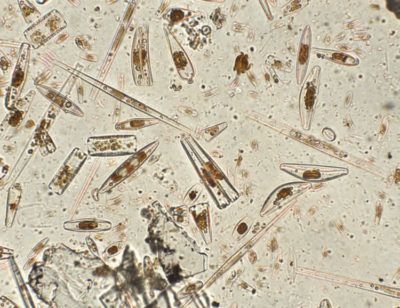
They are easily recognizable under a microscope because they have a siliceous external structure completely enveloping the cell, called a frustule.
Under a microscope, the frustule is transparent and rigid. Its shape defines the species of the diatom.
To check for the presence of diatoms, you can mix a small amount of 3% hydrogen peroxide with the sample. The hydrogen peroxide will destroy the organic matter, leaving only the diatom skeletons, which are easily observable under a microscope.
Diatoms during the startup of a reef aquarium
During the startup of a reef aquarium, with the addition of live rock, sand, or dry rock, diatoms will develop due to the silicon present in the tank.
Then, as the tank begins to stabilize, silicon levels will decrease, and consequently, the diatoms will naturally disappear.
Maintaining low silicon levels is essential to limit the development of diatoms.
How to combat the proliferation of diatoms
In a tank in the startup phase, diatoms are essential for feeding the microfauna and helping the tank stabilize.
In the case of a mature aquarium, their presence is not only unsightly but also harmful to SPS corals.
Unlike soft corals, which absorb phytoplankton and thus diatoms, a spread of diatoms smothers the base of SPS corals and leads to tissue necrosis.
The main sources of diatom growth
To combat the development of brown algae, it is necessary to focus on the nutrients required for their growth, particularly phosphates and silicon.
Maintaining low levels is therefore essential to limit their development.
Controlling the elements added to the aquarium will help verify if they are a source of nutrient input. Here are some leads:
RO water
In a mature tank, water high in silicon often comes from the RO water. We recommend performing an ICP test to confirm the presence of silicon (Si level) and then installing an anti-silicate deionizing resin.
After installing the resin, the Si level will remain low enough, and the diatoms will remain virtually invisible.
Synthetic salt
The salt used for water changes contains much more silicon than natural seawater. Performing water changes to remove diatoms will have the opposite effect, as it will boost the remaining diatoms, which will then spread.
Fertilizer
It would never occur to a reef aquarist to add fertilizer to a reef tank. However, if an aquarist cultivates phytoplankton at home to feed their aquarium and the culture protocol is not followed (stopping the addition of fertilizer at least 5 days before harvesting).
Fertilizer residues can thus be added to the tank along with the phytoplankton, promoting the development of existing algae and, consequently, diatoms.
Natural treatment for diatoms
After checking potential nutrient sources, the aquarium must be cleaned to remove existing diatoms.
We recommend cleaning the glass, blowing off the rocks, and vacuuming the bottom with a siphon.
Simultaneously, using a UV filter for a few hours will help eliminate diatoms present in the water column.
Finally, it is recommended to add zooplankton, which will feed on planktonic algae and thus diatoms. If the population of algae-eating snails is low in your aquarium, we recommend adding more.
The daily addition of phytoplankton will also be beneficial.
It will help develop the microfauna. Increasing the zooplankton population (especially benthic copepods that feed on diatoms) will be essential for regulating diatoms.
Simultaneously, adding phytoplankton will help the aquarium return to a stable reef biotope.